
Learning Outcomes
Defining Learning Outcomes
A learning outcome is a statement that identifies the knowledge, skills, and attributes students will learn if they take a course or program. They are written with the student in mind, using clear and plain language. Since learning is unpredictable and not guaranteed, and each student learns at their own speed, learning outcomes serve as ‘guideposts’ for both the teacher and student. The teacher uses learning outcomes to help design learning experiences and to offer guidance to students as they progress throughout those experiences. The student uses learning outcomes as an indication of where they are heading and how they will be expected to demonstrate learning.
Learning Outcomes:
- are direct statements about intended/anticipated student learning
- include the depth of learning expected by the end of a course/program
- are guideposts, reflecting the fact that learning is not predictable
- include the knowledge, skills, and values required by students to demonstrate learning of core concepts

Learning Outcomes vs. Objectives
Although outcomes and objectives are sometimes used interchangeably, it’s useful to understand how these two concepts are slightly different. The boxes below outlines the key differences between learning outcomes and learning objectives.
Learning Outcomes
- Are statements about anticipated achievements from students
- Are more student-centered and describe what the learner should learn
Learning outcomes are what is hoped students will learn along their journey and are often precise, specific, and measurable.
Examples of Learning Outcomes
By the end of this course students will be able to:
- Critically evaluate the connection between human rights and legal definitions of what is meant by ‘being human’.
- Describe four dimensions of culture and analyze the effects of those dimensions on communication.
Learning Objectives
- Are often written from a teacher’s perspective
- Are typically written in terms of an instructor’s teaching intentions
- Indicate what content a teacher intends to cover through instruction, curricula, programs or activities
Learning objectives are focused on specific types of performances that students are expected to demonstrate.
Examples of Learning Objectives
- This course will present different perspectives through the exploration of historical data and presentations by guest speakers, to explore concepts across time and space of what it means to be human.
- This course will introduce key dimensions of culture and explore how these dimensions influence communication.
There’s no ‘one size fits all’ to teaching and learning. At the same time, when students sign up for a course, they want an idea of what they will learn. Equally, as instructors, we benefit from having a road map to guide us. Learning outcomes are a tool we can use to describe to students the desired learning destination with an indication of:
- how they will travel
- what they’ll be expected to do along the way
- and where they’ll end up
NIC course outlines are required to include a list of course learning outcomes

One way of approaching writing a learning outcome is to think of it as comprised of three parts:
- Action Verb (Performance)
Considering what action might be involved in the learning outcome helps with figuring out what you want students ‘to do.’ An action verb is usually both measurable and observable.
- Learning Statement (Condition)
A learning statement (condition) that describes the learning to be demonstrated (e.g., in a written report, evidence based).
- Broad Criterion/Criteria
Broad criterion / criteria that give context / criteria for an acceptable performance (e.g., four dimensions of, the connection between…).

While learning outcomes are written at the beginning of the course design process, we also ‘inherit’ existing courses. Well-written learning outcomes keep the students front and center and are SMART:



- Specific – are clearly articulated and concise
- Measurable – can be demonstrated and / or are observable
- Achievable – reflect the level of the course
- Relevant – relate to the ‘real world’
- Timebound – doable within the time frame of the course
To begin:
- One place to start is to select an action word. Bloom’s Taxonomy and action verbs [PDF] are a good place to begin. For example: identify, analyze, classify etc. Or take a look at LaFever’s Sample Verbs and Progression.
- Select the subject content to which the action applies. For example: Identify the key steps in conducting an assessment.
- Decide whether the learning outcome needs a level of achievement (e.g., ‘with no mistakes’ or ‘effectively’) and / or a condition of performance (e.g., ‘independently’). For example: Independently [condition] identify [action verb] the correct order [level of achievement] of the key steps in conducting an assessment[subject content]. Not all learning outcomes require this third step.
How they relate to learning outcomes

Levels and processes of learning have been classified in various ways. These classifications (taxonomies) of learning help with writing learning outcomes because they provide a framework for articulating what you want students to learn.
There is no one right way of writing learning outcomes, and no one ‘best’ classification of learning. Choose the classification that makes sense to you and what you are teaching, and work from there.
For more information on different classifications, click on: Classifications of Learning [PDF]

Writing learning outcomes is a process and isn’t just about choosing the right verb. A learning outcome helps explain the demonstrable actions of students to provide evidence they have learned. In some cases, this can include more abstract actions (e.g., reflect on) and in these cases, thinking about how you will support students in demonstrating that ‘reflection’ will help you write that specific learning outcome.
As a starting point, the following verbs or phrases do not always provide an activity that students can demonstrate when considering cognitive, psycho motor and affective activities:
- understand, know, appreciate, comprehend, realize, be aware of, be familiar with, realize
- learn, cover, study, gain knowledge of, become acquainted with
If it’s not clear how you would measure the learning outcome, rewrite it so it’s clearer what you are expecting students to learn, do etc.
Below are some simple examples of existing learning outcomes improved.
Vague / Hard to Measure
Better
Understand osmosis
Accurately explain the process of osmosis
Study trigonometry
Apply trigonometry to solve measurement problems
Be aware of why the Russian Revolution happened
Critically analyze the events that directly led to the Russian Revolution
To show you how to move from an incomplete to a better to a good learning outcome, see the examples below.
Example 1
Incomplete
Students will be able to write a lab report
(While a student knows they have to write a lab report, they have no idea how they will know if they’ve succeeded, as there are no criteria)
Better
Students will be able to write a lab report following the institution’s lab report format.
(added criterion – following the specific format of the institution)
Good
At the end of the lab portion of this course, students should be able to write a lab report following the institution’s report format.
(added the condition under which the behaviour will occur – at the end of the lab portion of the course’)
Example 2
Incomplete
Students will use technology effectively.
(This is vague – what technology? What will they do with the technology, and what does ‘effectively’ look like? )
Better
Students will utilize word processing, spreadsheets, and presentation graphics to prepare their final business report and project professionally.
(Students know ‘which technology’ they’ll learn in the course)
Good
By the end of this business course, students will be able to effectively use word processing, spreadsheets, and presentation graphics to prepare their final business report and project professionally.
(with the added condition under which the behaviour is occurring – through preparation of the final business report and project – students know exactly what they will learn)
Figuring out how to assess students can be challenging. There are various considerations, including the timing of assessment, the number of students involved, and external constraints (e.g., guidelines of provincial governing bodies), etc.
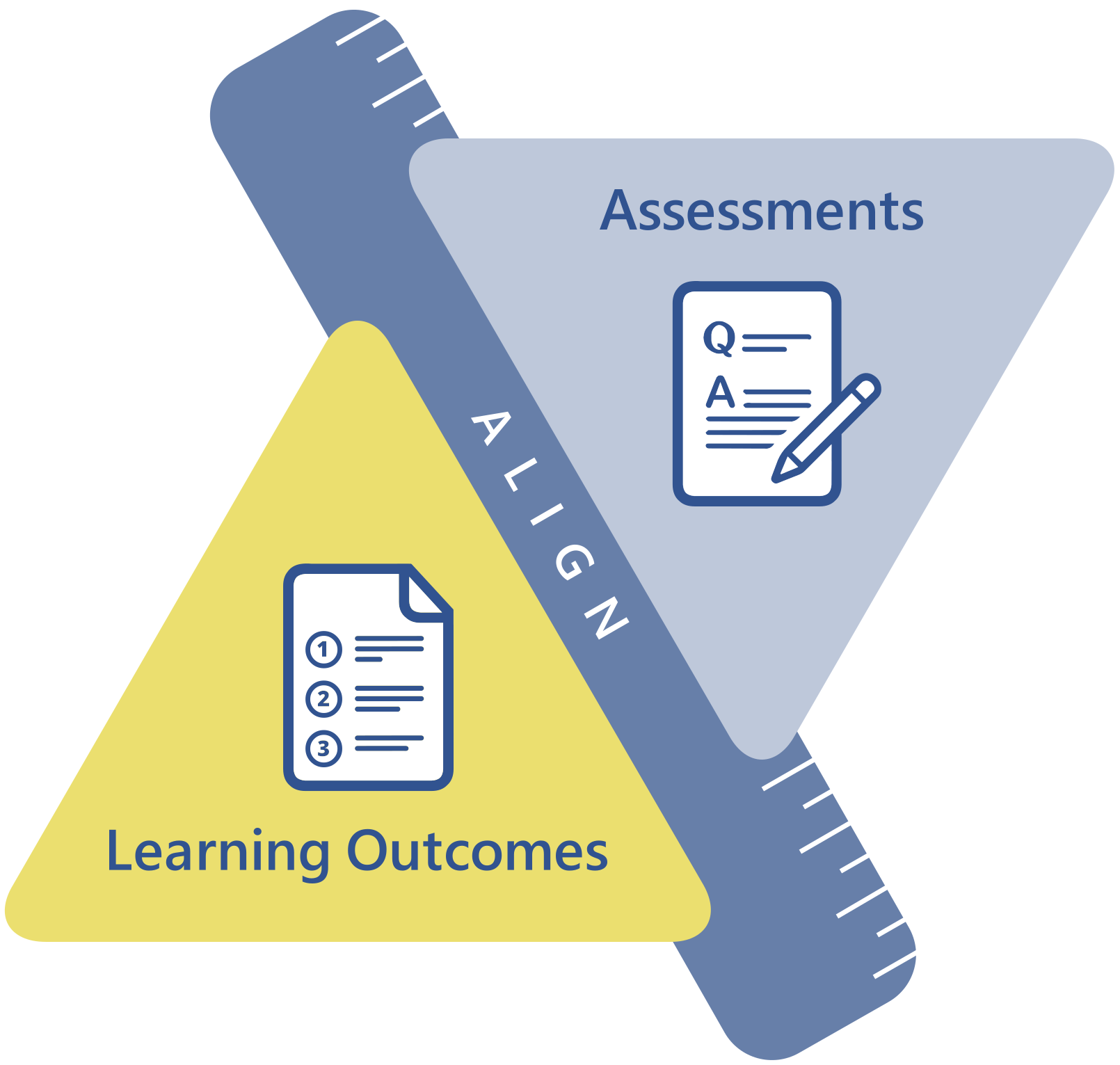
Another consideration is how to align learning outcomes with assessment. Alignment means ensuring there is a direct connection between the ‘what’ and the ‘how’ of assessment. For example, if we want to understand students’ understanding of a concept, we might decide that asking students to apply the concept to a case study might provide a more accurate assessment of student learning than asking them to respond to a multiple-choice quiz. On the other hand, to assess knowledge that needs to be memorized to provide foundational knowledge for higher-level thinking/knowledge application, a multiple-choice test might be the best choice.
The advantages of aligning assessment with learning outcomes include:
- greater accuracy in identifying what students have learnt and the areas in which they need further support
- increased engagement of students in the assessment process
- opportunities to use methods beyond timed exams that are hard to employ fairly in an online environment
- potential for fewer issues relating to academic integrity