
NIC AI Assessment Scale
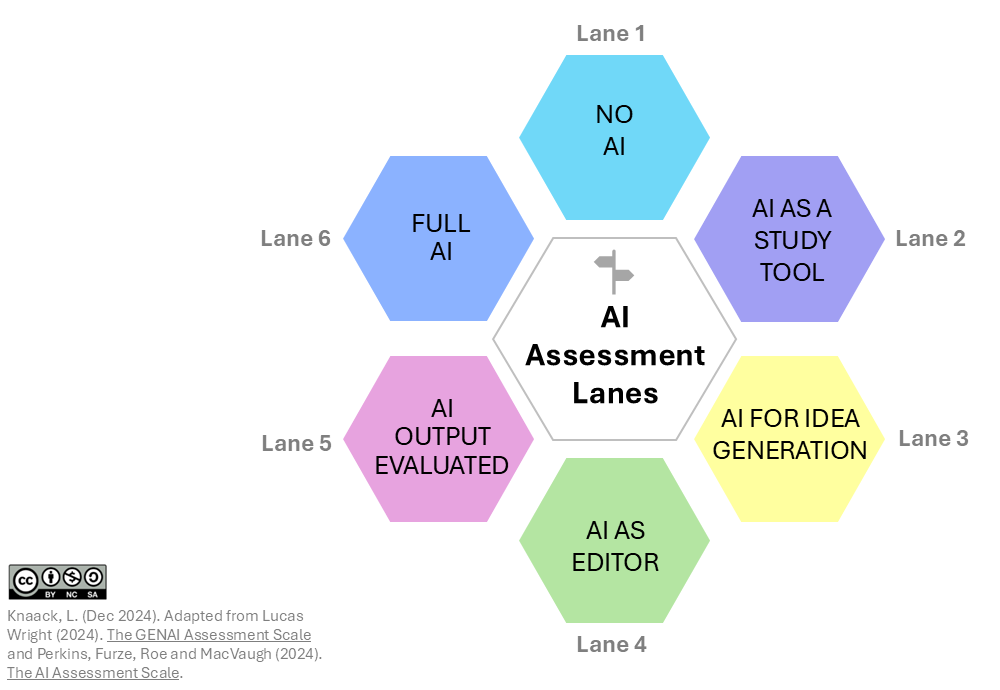
North Island College’s 6‑lane AI Assessment Scale provides a clear, flexible framework to guide how artificial intelligence can (or cannot) be used in student assessments. Ranging from “No AI,” where students demonstrate learning independently, to “Full AI,” where AI is fully integrated into the assessment process, the scale helps instructors align AI use with learning outcomes and assessment goals. Each lane sets transparent expectations for students, supporting academic integrity while also building critical skills in areas like evaluation, editing, and responsible AI use.
NOTE: A protected version of Microsoft Copilot is available to all North Island College students and staff through the Microsoft Office license. Other AI tools may require accounts, fees, and store personal data on servers outside Canada. Consider allowing students to opt out of non-protected tools if they have concerns about cost, privacy, or security. For more information about AI at NIC, visit the Artificial Intelligence page.
Following is a chart of the six lanes of how AI can be an assistance to you in your learning. When the word assessment is used in the chart below it could mean either the formal or informal components of assessment. The word assessment can mean two things: 1) a formal evaluation of learning that is assigned a value (mark, grade, level) that contributes to the final grade. (e.g., a test, project, assignment, exam, assignment) and 2) informal engagement of learning that is not assigned any value (mark, grade, level) contributing to the final grade (e.g., a discussion, quiz, readings, group activity etc.).
Please note which course assessments fall under each level, and feel free to use the Student AI Disclosure Form [Word] or [PDF] with your students.
Lane |
Student Expectations |
Notes for Instructors |
|---|---|---|
1. NO AIAI Must Not |
|
This lane is used when you want full original demonstration of student learning that aligns with the learning outcomes without the use of AI tools. This lane is idea for testing core knowledge and comprehension. Examples:
|
2. AI AS A STUDY TOOLAI Used as a |
|
This lane is for being clear with students that they are allowed to use AI as a study mechanism. Given that you are unable to monitor out-of-class activities, you would use this lane for an assessment to be clear with students about the use of AI for studying. You may practice use of this in class, share how to write prompts to have GPTs act as a tutor or point out tutors that have been developed to provide study supports. |
3. AI FOR IDEA GENERATIONAI Used to Enhance Brainstorming |
|
This lane is when you are okay with students getting ideas and generating possible directions using GenAI as they may already do with friends, family and search engines. This lane is suitable for assessments for demonstrating writing skills. Students may use AI tools to generate ideas for an essay or report. AI may provide student assistance in getting started, expanding on initial thoughts or providing other perspectives. |
4. AI AS EDITORAI Provides Feedback for Improvement |
|
This lane is used when you want the students to produce original work, but they can use AI tools to edit, get feedback on areas for improvement and create citations and references. AI acts like an editor. |
5. AI OUTPUT EVALUATEDAI Results are Critically Evaluated |
|
This lane is useful when you want students to develop a deeper level of engagement with course materials, undertake more independent learning and developing skills involved in evaluating the information produced in this AI era. You would choose assessments where you want to see student analyses of AI results, comparisons of other data sources, exploring what is true and not true, etc. |
6. FULL AIAI is Integral to |
|
This lane is used when the AI output/submission may use previously created original work. Examples of assessments might include: input notes from a group discussion to generate a summary, production of themes from a number of individual presentations, collating research findings into a summary report, students submitting original design concepts for a proposed urban planning scenario and having AI generate a visual representation of those ideas etc. |
Attribution
The work was inspired and developed from the already amazing work done by these educators around the world specifically these listed below:
- Wright, L. (2024). The GenAI Assessment Scale.
- Furze, L (August 28, 2024). Updating the AI Assessment Scale.
- Furze, L. (May 20, 2024). The AI Assessment Scale in Action: Examples from K‑12 and Higher Education Across the World
- Furze, L. (May 23, 2024). The AI Assessment Scale GPT: Aligning your Assessment with the AIAS
- Furze, L. (Dec 18, 2023). The AI Assessment Scale: Version 2
- Perkins, M., Furze, L., Roe, J., MacVaugh, J. (2024). The Artificial Intelligence Assessment Scale (AIAS): A Framework for Ethical Integration of Generative AI in Educational Journal of University Teaching and Learning Practice, 21(6).https://doi.org/10.53761/q3azde36
- Liu, D. (April 2024). University of Sydney – Menus, Not Traffic Lights: A different way to think about AI and assessments
- Bridgeman, A. & Liu, D. (July 2024). University of Sydney – Frequently asked questions about the two-lane approach to assessment in the age of AI
- Steel, A. (July 2024) Director AI Strategy, Education, UNSW Sydney in 2 lanes or 6 lanes? It depends on what you are driving: Use of AI in Assessment
- Teaching and Learning Services, Carleton University in Generative Artificial Intelligence: Recommendations and Guidelines, October 4, 2023