
Improve
Community-Based Learning (DONE)
High Impact Practices (DONE)
Metacognition (DONE)
Reflective Practice (DONE)
Socratic Method (DONE)
Threshold Concepts (DONE)
Peer Observation (DONE)
NIC Course Feedback Survey Service (Mid-Course and End-of-Course Versions)
Everything is fine on this page except for the redundant navigation buttons below. Recommend deletion of “How to opt in”, “Resources”, “Questions”
NIC has an institutional survey that is an informal, formative set of course and instructor questions aimed to provide instructors with confidential feedback on their courses at the mid- and end-points. Course feedback is about gathering input on what is going well and where enhancements can be made. It is aimed to give students a voice and give faculty inputs to support the student learning experience and their own professional development.
The Centre for Teaching and Learning Innovation manages this survey service. Presently, this service is not available to Continuing Education or Accessible Education and Training programs.
By default, each course is opted OUT of the survey. To opt your course in, and for more details, see below.
HOW TO OPT IN
Watch the following 10:53 minute video to learn how to opt in to NIC’s Course Feedback Survey service, or read How to Opt In [PDF]
Top of Page
Resources
Questions
Top of Page
Course Redesign
AI in Assessment (Edit — is design consistent with new site — is content still current? Update Links to Helpful Resources)
Alternative Assessment (Edit — is design consistent with new site — is content still current?)
The more I look at other T&A sites, the more I am struck with the lack of specificity. Other sites are general, open, and encourage faculty to engage with the T&L reps to investigate or develop things specific to their area. I am hesitant to keep course redesign on the site. The AI assessment should be deleted, as AI content will show up under another technology & assessment. This would mean there would be an entire tab devoted to Alternative assessment, which I do not believe requires the same hierarchical placement among Pedagogies, Teaching feedback, PD & Program review. Delete entire tab?
Professional Development
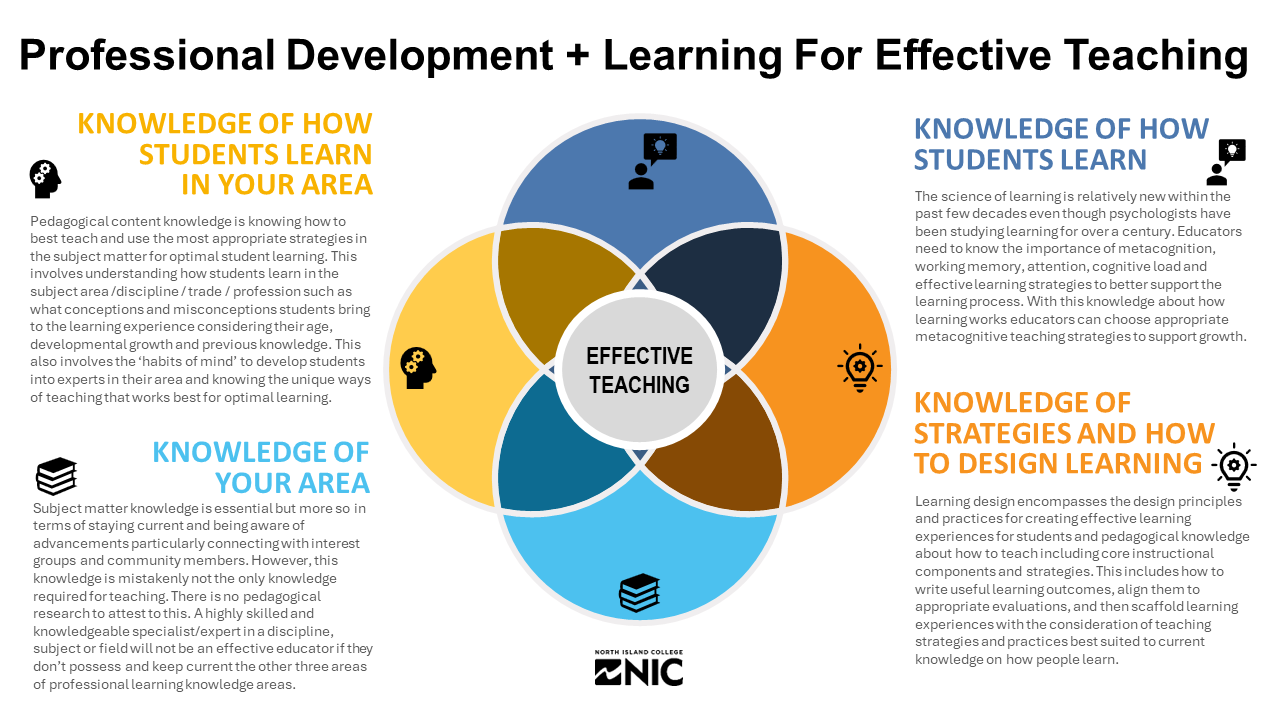
College and university instructors most often come to the position without strengths in all four knowledge areas. When instructors are building their professional development plan they should consider a balanced approach of all four components and a variety of formats such as conferences, workshops, symposia, book reading, peer observation, portfolio development, and scholarly activities such as action research and student engaged projects.
Most often instructors tend to focus on the bottom left area (knowledge of area — subject, discipline, trade etc) to ensure they are current and teaching the most appropriate content. But the top two areas are equally important in terms of having knowledge about how students learn the discipline/subject area. Instructors need to be acutely aware of what prior knowledge students often bring to the classroom and what common misconceptions and conceptions they hold about the topic or discipline to be studied. The science of learning (how learning and thinking works) has a significant impact on understanding learners and their learning journey. When educators have a broader understanding of how the brain works along with memory, cognitive load and attention, they can better design a course and respond to student needs.
Learning design is another core knowledge piece that often isn’t always picked up on the job. Learning design is the skill set about how to ‘build the learning house’ (aka the course) from foundation to the roof and all that is in between. This is more than just following a textbook set of chapters and slide decks. Learning design starts with good learning outcomes and then creating an aligned course with linked application activities and demonstrations of learning. Learning design ties all the pieces together with the foundational knowledge of teaching and learning practices and pedagogies and then links all courses under the program or credential area for an holistic learning experience.
Connect with CTLI for ideas on different PD activities that are relevant for you!
Self-Enrol Brightspace Courses (Cannot find this page, perhaps it is simply a link to Brightspace? If so, lets explain that there are courses available for self enrollment in brightspace that instructors can use for Professional Development. We won’t list what the courses are, as this will change, but will provide a basic link to that location of Brightspace.)
**If this is already on the NIC website, I think it is both redundant and confusing for it to be listed here. Lets delete this entire option.