
Socratic Method
Encouraging Self-Reflection and Deeper Thought Through Open Discourse
Developed by the Greek philosopher, Socrates, the Socratic Method is a dialogue between teacher and students, instigated by the continual probing questions of the teacher, in a concerted effort to explore the underlying beliefs that shape the students views and opinions. Though often misunderstood, most Western pedagogical tradition, from Plato on, is based on this dialectical method of questioning. (Colorado State University, The Socratic Method: Fostering Critical Thinking)
Overview of Socratic Method
 The Socratic method, a cornerstone of effective teaching, has been utilized by both novice and experienced educators across all levels of education. Named after the Greek philosopher Socrates, this pedagogical approach is renowned for its ability to foster profound student engagement. While diverse interpretations of the Socratic method exist, they are all rooted in the original principle of dialogical inquiry, distinct from more traditional lecture-based or “sage on the stage” models of instruction.
Over time, the Socratic method has often been conflated with the basic act of speaking at students, and furthermore, it has sometimes been applied as a generic instructional technique across disciplines rather than as a focused philosophical tool designed to explore complex concepts and arguments. This page explores best practices for implementing this engaging and thought-provoking classroom strategy.
Benefits for Student Learning
The advantages of using the Socratic method are well-established. This instructional approach fosters a community of learners who are encouraged to critically examine their own biases and perspectives regarding complex ideas. In this model, the instructor does not function as a purveyor of knowledge or a coach, but rather as a facilitator of dialogue.
Through open-ended, probing questions, the instructor helps students explore their own values, principles, beliefs, and biases. Instead of merely transmitting facts, the Socratic method aims to uncover and examine a student’s thinking about those facts. This type of facilitation builds a sense of community within the class as students engage in dialogue with each other and the instructor, defending their viewpoints while remaining open to considering other perspectives.
Components
Although opinion varies on precisely what the Socratic method can be defined as, there are agreed to be at least 4 essential components:
- Question-Driven Inquiry: The Socratic method uses carefully crafted questions to explore students’ values, principles, and beliefs. The instructor initiates the discourse, then prompts students to articulate and defend their answers. The atmosphere should be one of mutual respect and intellectual exploration, not confrontation.
- Focus on Ethical and Moral Reasoning: The Socratic method lends itself well to course content that is not solely focused on concrete facts or procedures. Areas such as morals, societal norms, ethics, and law offer fertile ground for this instructional style
- Embracing “Productive Discomfort”: The Socratic method relies on a classroom environment where “productive discomfort” is embraced. Students engage in group Q&A, which can lead to discomfort as they articulate and defend their positions. This is not intended to be a debate with clear winners and losers; rather, it’s about exploring different perspectives and the reasoning behind them.
- Exploration of Complexity: The Socratic method is particularly effective for illuminating complex issues, difficulties, and uncertainties rather than simply eliciting factual recall. Topics where divergent opinions can naturally emerge and be explored provide the ideal context for this method.
The importance of acceptance of diverging opinions is important in the Socratic method. The instructor will determine the tone of the classroom, which in turn determines the degree of vulnerability students will be willing to engage with. Often the Socrates method works best on topics that do not have a correct or wrong response. Taking this into account can make using the Socratic method a challenging task.
Preparing Your Students
To aid in this approach, it can be helpful to provide structure for your students. Since this may be unfamiliar territory their understanding of how to respond to statements and questions may differ significantly. To avoid miscommunication or creating a right/wrong atmosphere, consider discussing these steps with your class prior to starting a Socratic Method class: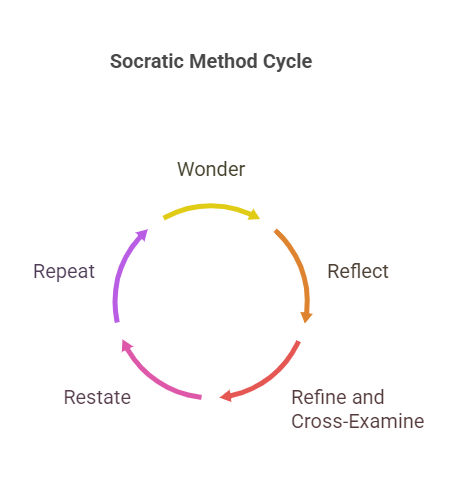
- Wonder: Receive what the other person has to say, and listen to their view or premise.
- Reflect: Sum up the person’s viewpoint and clarify your understanding of what you have heard.
- Refine and Cross-Examine: Ask the person to provide evidence that supports their view, Discover the thoughts, assumptions, and facts underlying their beliefs. Challenge these assumptions to test their validity
- Restate: Note the new assumption resulting from the inquiry
- Repeat: Start back at the beginning with the new assumptions. This process helps drill down to the core issues to arrive at the best version for whatever you’re looking for.