
Collaborative Online Indigenous Intercultural Learning (CO[I]IL)
We know that for solving complex problems, diverse groups perform better than homogenous ones. We also know that with diversity comes a greater possibility of misunderstandings. Providing students with experience working across diversity in a supportive and safe environment is an essential part of a college education.
In this section, we explore a Collaborative Online [I]ndigenous Intercultural Learning (CO[I]IL) Pathway that supports instructors in creating collaborative projects that interweave Indigenous and intercultural perspectives.
What is CO[I]IL? (Accordian 1)
Collaborative Online Indigenous Intercultural Learning or CO[I]IL is an Indigenous-focused virtual exchange whereby two or more faculty based in different countries and institutions collaborate to develop a series of synchronous and asynchronous activities for their students. Students complete the activities in international teams using digital collaboration and communication tools.
CO[I]IL uses technology and the Internet to bring diverse faculty and students together—across borders of
time, space, language, culture, and discipline—to engage in peer-to-peer intercultural dialogue and
meaningful projects that support developing intercultural fluency and an understanding of different cultural contexts.
What is the Difference Between Traditional COIL and Collaborative Online Indigenous Intercultural Projects? (Accordian 2)
While traditional Collaborative Online Intercultural (or International) Learning projects focus on providing students and instructors with in-class international and intercultural experiences, CO[I]IL goes one step further by developing Indigenous-focused local community-based projects, interweaving both local and global perspectives.
Traditional COIL projects have four key dimensions
- Teachers and students collaborate within and across classrooms
- Online technology and interaction are essential components
- International and intercultural learning is central
- The project is integrated into existing credit-bearing courses
CO[I]IL braids together Indigenous and intercultural ways of being and knowing within an international Indigenous-focused project, and is founded on the following guiding principles:
- A non-Indigenous instructor and an Indigenous instructor come together in a partnership of collaboration and reciprocity
- The project reflects and integrates Indigenous pedagogical approaches (see Facilitating online learning with the 5R’s: Embedding Indigenous Pedagogy into the Online Space, based on Kirkness & Barnhardt’s (1991) 4R’s of Indigenous pedagogy as a starting point, and also seeks out local resources where available)
- The project prioritizes the needs of Indigenous communities local to each institution, ensuring that final class projects benefit these communities
- Both faculty and students engage with Indigenous communities local to each partner institution, focusing on the needs of the local community
Introducing the CO[I]IL Pathway (Accordian 3)
The CO[I]IL Pathway guides instructors through every step of the CO[I]IL experience, allowing teachers to enter the process at the point most appropriate for them, encouraging an iterative and ongoing cycle of learning, engagement, and reflection.
This Pathway interweaves Indigenous pedagogies, intercultural perspectives, and land-based approaches with academic expectations and can be adapted to the priorities of any community/context within which the Pathway is utilized.
“Central to the Pathway and important at each step, is the focus on the local, on relationship building, and reciprocity.”
This collaborative Pathway is evolving through dialogue with stakeholders and communities across five BC partner institutions, along with international partner institutions.
Drawing on existing expertise within the network ensures intercultural competencies and agreed-upon Indigenous pedagogical approaches are prioritized, in culturally appropriate ways across contexts, to ensure local communities remain at the center. Inherent within Indigenous ways of knowing and integral to the Pathway are the Sustainable Development Goals (SDGs). Considering the SDGs in CO[I]IL project development enhances our ability to connect with Indigenous priorities and goals on a local and global level.
At the heart of this CO[I]IL Pathway lies the commitment to reconciliation, decolonization, and Indigenization, with the voices of Indigenous communities leading the conversations.
The Pathway takes faculty through the following steps: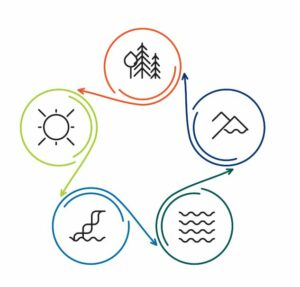
- Positioning: Walking in a Good Way
- Interweaving: Braiding the Indigenous and the Intercultural
- Community Building: Co-creating Projects
- Connecting through Kinship: Engaging in CO[I]IL
- Reflecting and Reciprocity: Moving Forward in Reflective Circles
Positioning: Walking in a Good Way (Sub-Accordian 3a)
This requires rigorous and ongoing self-reflection, vulnerability, and a willingness to shift and grow through mistake-making and experiential learning. Walking in a good way means:
- understanding our own story and connection to the land
- honoring the local: prioritizing the land we walk on
- reflecting on your heart and spirit
Interweaving: Braiding the Indigenous and the Intercultural (Sub-Accordian 3b)
Interweaving refers to how Indigenous perspectives and ways of teaching are interwoven with intercultural perspectives and ways of teaching, within a CO[I]IL project. This process includes:
- exploring what it means to be Indigenous-focused
- developing intercultural fluency
- braiding different ways of knowing and being: interweaving the Indigenous and the intercultural
Community Building: Co-creating Projects (Sub-Accordian 3c)
This means ensuring land-based learning remains at the center of the Indigenous-focused online project. It means acknowledging and honoring the lands local to those participating in the project (at home and overseas) and seeking guidance from local knowledge keepers and others, to ensure we make appropriate and respectful connections with local Indigenous communities as we co-create projects that focus on what is important to the people on whose lands we walk. It includes:
- working well with local Indigenous communities to identify a project
- choosing an international partner
- getting practical — understanding CO[I]IL logistics
Connecting through Kinship: Engaging in CO[I]IL (Sub-Accordian 3d)
Students and instructors across classrooms work to foster community and connection before students begin on their joint exploration. This begins by:
- coming together through ‘Stories of who I am’
- engaging in local community-based projects
- learning from each other
Reflecting and Reciprocity: Moving Forward in Reflective Circles (Sub-Accordian 3e)
This step recognizes the ongoing and iterative nature of CO[I]IL and is an opportunity to demonstrate an ongoing commitment to developing Indigenous-and intercultural-focused pedagogies and practices. It involves:
- reflecting on the path we took
- reflecting on our new story
- giving back and moving forward: contemplating the next steps in our CO[I]IL journey
Getting Ready for CO[I]IL (Accordian 4)
CO[I]IL braids together Indigenous and intercultural ways of being and knowing within an international Indigenous-focused project.
Being Indigenous-Focused (Accordian 4a)
Being Indigenous-focused means weaving together various threads to create a tapestry of understanding. This begins with ensuring we are ‘Walking in a good way,’ which requires rigorous and ongoing self-reflection. It means knowing where we are, where we come from, the stories that have shaped us, and how we walk ‘in’ and ‘on’ the world. It means being aware of our inherent connections to other beings and the unavoidable and significant impact we have on all beings around us. In her book, Wayi Wah! Indigenous Pedagogies — An Act for Reconciliation and Anti-Racist Education, Chrona (2022) shares:
“[o]ne important aspect of Indigenous Knowledge Systems is that they respond to, and honour context. Who I am, where I write from, and the land I am now on informs what I share with you. Knowledge and understanding are entrenched in relationship and connected to people and place (p.1).”
Reflecting on who we are as holistic beings shaped by story is an ongoing and iterative process that goes hand-in-hand with understanding what it means to be Indigenous-focused. We also need to have an understanding of Decolonization, Reconciliation & Indigenization. As instructors, it is not our role and responsibility to become the experts and disseminate knowledge of culture, intangible cultural heritage, worldview, or customs of others. It is our role and responsibility to draw on the knowledge of our students, to facilitate their learning and discovery of one another.
Intercultural Fluency (Accordian 4b)
Although there is no one agreed-upon description of intercultural fluency (sometimes called ‘intercultural competence’), a commonly accepted definition comes from Deardorff (2008):
“effective and appropriate behavior in intercultural situations ”
Deardorff’s (2009) Intercultural Competence Model identifies attitudes, knowledge, skills, and internal and external outcomes as the five key elements of intercultural competence, highlighting that it is a process, not an ‘end product’ that can one day be fully achieved.
Across different definitions available, most researchers agree that intercultural fluency includes the ability to:
- understand and respect other worldviews and cultures
- actively listen and engage with diverse others
- a willingness to tolerate ambiguity
- develop cultural self-awareness and a capacity for self-assessment
- develop an openness toward intercultural learning and empathy for people from other cultures
- adapt to varying intercultural communication styles
Learning intercultural fluency is important for all students
Helping students to develop their intercultural fluency is important, regardless of whether they plan to travel, work abroad, or leave their communities. Every day we communicate with other humans, whether face-to-face or online, through email or conversation. And while we have our ‘human-ness’ in common, we are all unique in terms of our cultural identities, life experiences, and how we engage with the world around us. Understanding others may not understand and view the world the way we do, is a critical life skill for all students.
Intercultural Perspectives on Classroom Dynamics
While it’s important to avoid overgeneralizing, exploring potential differences in how students have been acculturated in educational contexts within and outside of Canada helps instructors and also students to better understand the perspectives and behaviors of others. A useful starting point is Hofstede’s Country comparison tool, demonstrated in the 3‑minute video below, which provides opportunities for discussion of broader cultural trends across different countries.
Hofstede’s article referenced in the video, Cultural differences in teaching and learning (Hofstede, 1986), while several years old, remains a useful starting point.
Intercultural fluency and teaching
Our personal experiences of learning influence how we, in turn, teach — whether we reproduce how we were taught, or we do something different because we didn’t enjoy our own experiences of education. Whichever choice we make, the context in which we live influences these choices.
As instructors, we continually reflect on ‘how’ we teach, and the methods and activities we use. We think about ‘what’ we teach our students. We ask ourselves, what they need to learn.
“How often do we think about the ‘why’ of what we do?”
Understanding the values and beliefs that underpin the pedagogical decisions we make
Taking time to reflect on our cultural values and beliefs as they relate to teaching, supports us in creating learning spaces that value the cultural diversity in our classrooms, by:
- helping us identify the specifics of how we see the role of an instructor (sage on the stage, guide on the side, etc.)
- highlighting our (often) subconscious beliefs about the role of students
- identifying our expectations of student behavior in the classroom
- highlight our teaching biases/preferences that may inadvertently disadvantage some students
Creating Projects (Accordian 5)
When creating a project, we need to consider:
- How to work appropriately and respectfully with local Indigenous communities to identify a project
- How to choose an international partner
- The practical implications of CO[I]IL projects
You can download more information by clicking on a summary of this page via a PDF: Creating Projects, or continue to read on.
How to Work Well with Local Indigenous Communities to Identify a Project (Accordian 5a)
A guiding principle of the CO[I]IL Pathway is for projects to be co-created with at least one Indigenous instructor who lives in and/or works very closely with the local Indigenous community. For example, a non-Indigenous NIC instructor would choose to do a project with an Indigenous instructor at a partner institution. An Indigenous NIC instructor could decide to do a project with either a non-Indigenous or an Indigenous instructor at a partner institution. Indigenous communities must remain at the heart of the project. ALL instructors would connect with the Indigenous community (ies) connected to their institution.
What ‘connection’ entails will vary according to:
- our positioning — how we are ‘in relation to’ the community and our identity (e.g., Are we a community member? Were we born locally and not a member of the local Indigenous community? Are we a newcomer to Canada? etc.)
- the needs of our local Indigenous community(ies)
- Indigenous institutional resources available (e.g. at NIC, the Elders in Residence, the Indigenous Education Navigators, NIC’s Indigenous Education News website, the Working Together Working Group, and the Indigenous Education Council)
It’s important we do our research, and find out what we can about our local Indigenous community (ies) and their needs and interests. Finding out as much as we can from readily available sources (e.g., the Internet, local organizations, our institutional resources and connections, etc.) ensures that when we do reach out personally, we are doing so respectfully and appropriately.
Choosing an International Partner
There are several factors to consider when identifying which international partners might be a good fit for you and your class, including:
- do you already have overseas connections / established relationships that would be suitable for your project? Have you researched a current list of institutional partners?
- do you speak any languages in addition to English (again, not necessary), that could help when communicating with a possible project partner?
- how flexible (e.g. in terms of language, time zones, etc.) are you in how you connect with your partner institution?
- how comfortable are you in navigating cultural differences in a classroom context?
- would you be interested in connecting with a class from a different discipline?
Getting clear on your responses to the above questions will help you narrow down, how best to identify potential international project partners for your CO[I]IL project.
CO[I]Il Logistics – Getting Practical
When planning a CO[I]IL project, it’s important to consider various logistics. These will influence what can easily be achieved, when, and how. Thinking about the following before starting project design is a good idea.
Language
In international collaborations, not all participants (instructors and students) will likely have English as their first language. It’s important to consider what the main language of communication will be during project planning and implementation if translation will be needed, and how you plan to help students navigate any language differences.
Time zones
In addition to class schedules, whether or not students (and instructors) can meet ‘live online’ during class time will also depend on whether or not project partners share the same or similar time zones (e.g., only a few hours difference).
Technology
Institutions, instructors, and students may use different educational platforms and technological tools. We also need to consider our own and our students’ familiarity and comfort level with technology, as well as that of our project partner and students. While we may not know who is using what at the initial project planning stage, reflecting on what tools we’d like to use and being open to learning new ones, is an important part of planning a CO[I]IL.
Collaborative Tools
While the list of possible tools is endless, it’s okay to choose one or two that will work best for us, bearing in mind:
- availability and experience using the tool
- accessible and inclusion
- privacy concerns (ideally students should not have to provide any personal identifying information to use a tool and if they do, they need to be aware of this and have alternatives if they aren’t comfortable providing their information
Learning Outcomes
While we can’t assume other institutions require courses to have learning outcomes (LOs), thinking about how our proposed CO[I]IL will help students meet one or more learning outcomes is worth considering at the planning stage, especially if you’re looking for project ideas that connect community needs and the course into which you plan to incorporate your CO[I]IL project.
Assessment
Assessment requirements, criteria, and practices may vary across partner institutions. It will be important to have a conversation about assessment right at the beginning, especially where a CO[I]IL project is included in a course that has externally mandated evaluation criteria.
Project Implementation
Every project will be unique. That said, there are two important elements that every CO[I]IL project will include.
Connecting through kinship: engaging in the project
This step of the CO[I]IL is what people sometimes see as the main part of the project, although in fact, it is a step on a much larger and longer journey.
A project can last one class, one week or several weeks across a term. It involves students across institutions working together in diverse groups to explore a given topic or problem. The traditional COIL ‘ice-breaker’ is replaced with ‘Stories of who I am,’ fostering community and connection before students embark on their joint exploration.
Reflecting and reciprocity — moving forward in reflective circles
A key aspect of a CO[I]IL is reflection, not only for students but also for instructors. Reflection is important at every stage along the Pathway, and most especially at the end, before embarking on a new project.