
Alternative Assessment
Overview of Alternative Assessment
Definition and purpose
Alternative assessments are educational evaluation methods that emphasize the application of knowledge and skills in real-world or meaningful contexts, moving beyond traditional standardized testing.
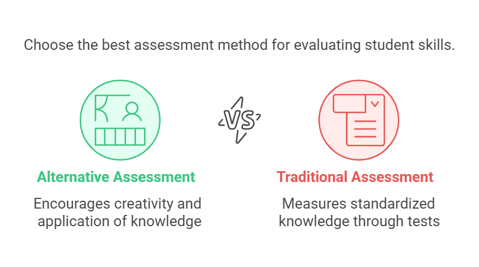
Alternative assessment encompasses various methods that differ from traditional standardized tests. Alternative assessment includes approaches like integrative and holistic assessment, focusing on students’ abilities to apply knowledge in novel ways. Alternative assessment “is predicated on the view whereby, the student, the text, and the context impact learning outcomes” (Janisch, Liu, & Akrofi, 2007, p. 222), and strong consideration is required to choose the most appropriate assessment to achieve the desired results.
The primary purpose of alternative assessments is to provide a more comprehensive evaluation of student learning by emphasizing meaningful tasks that reflect real-world applications. This approach aims to enhance student engagement, promote deeper understanding, and develop skills that are transferable beyond the classroom.

Many students prefer this form of assessment because it removes the stress of grades to focus on learning. Some schools also use a pass/fail system, in which a student either passes or fails a class.
Alternative assessments cater to different learning preferences and can provide a more holistic understanding of a student’s strengths and areas of improvement. Alternative assessments also encourage reflection and metacognition.
Columbus State Community College has a variety of resources and videos about alternative assessment basics. There are many examples to consider when changing assessment strategies.
The 4 Pillars of Alternative Assessment
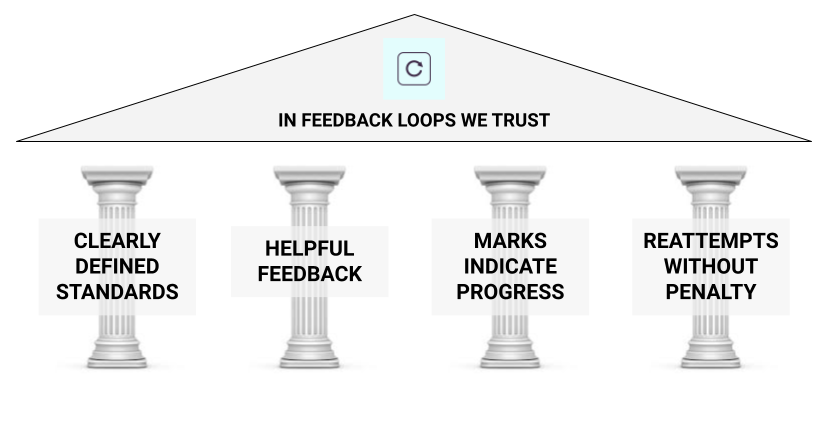
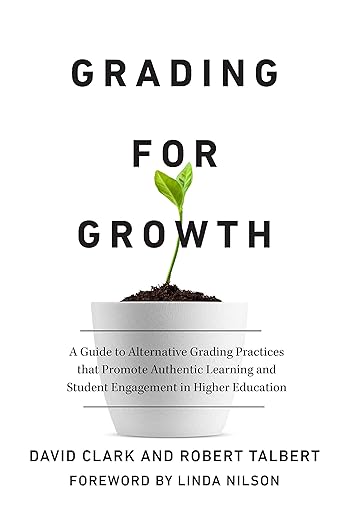
David Clark and Robert Talbert’s book “grading for growth” identifies 4 pillars that are required for alternative grading with an emphasis on feedback. This article breaks down the 4 pillars and is written by Robert Talbert.
Alternately, David Clark talks about his experiences with alternative assessment, discusses benefits and challenges and provides concrete examples of how to apply.
You can watch the discussion in the 19-minute video below.
Course Redesign: Alternative Assessment
Getting Started: Considerations and Best Practice
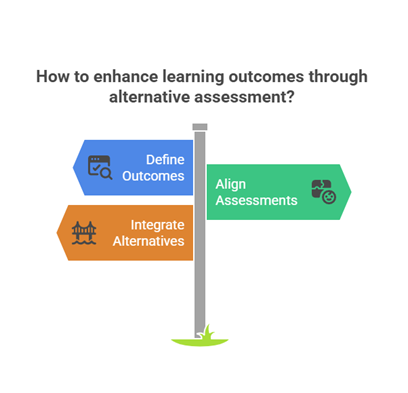
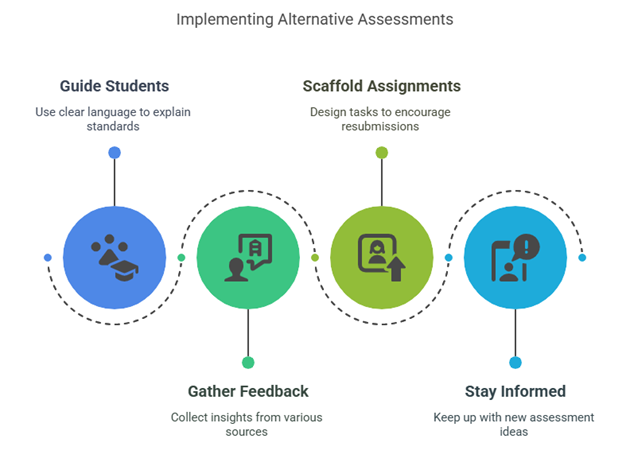
When changing an assessment or enhancing an existing one, there are steps to be considered. The resources available on Teach Anywhere consistently emphasize to start small. Perhaps you begin with adjusting a rubric or you replace an assessment that you inherited when you took over the course and that you feel does not accurately evaluate student learning.
These pages about alternative assessment have been developed with the 4 pillars of alternative assessment in mind.
Tips to Begin
The 4 pillars are indicated in relevant areas throughout.
Learner Readiness + Professionalism Checklist
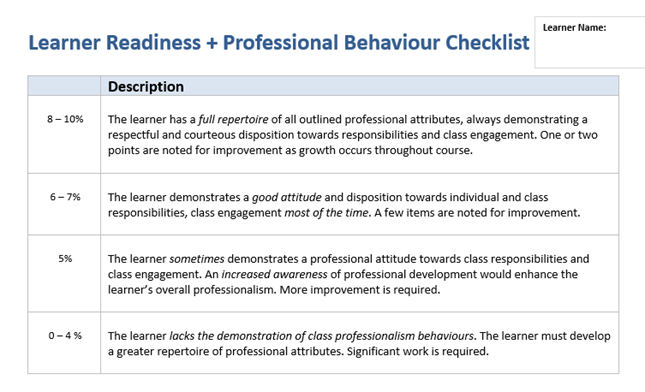
Participation marks are controversial in post-secondary education are often controversial due to their subjective nature for both students and instructors. Bain (2019) argues that instructors should view participation grades as opportunities for “skill building “ opportunities and offers strategies to help manage this approach.
CTLI provides an alternative to traditional participation grades, building on Bain’s suggestions by encouraging students to self-assess their behavior on the classroom. The learner behavior checklist replaces instructor – observed participation, shifting responsibility and accountability for behavior to the students. This way, any deduction marks are made by the students themselves, not the instructor.
As Bain (2019) suggests, the checklist is provided at intervals throughout the semester, allowing students ample time to identify challenges and adjust. It also includes a section for reflection to promote metacognition.
The checklist is provided here in a Word document, enabling instructors to customize descriptions and criteria. Alternatively, this can be done as a large group activity, involving students in setting the criteria in the early part of the semester.
Ungrading

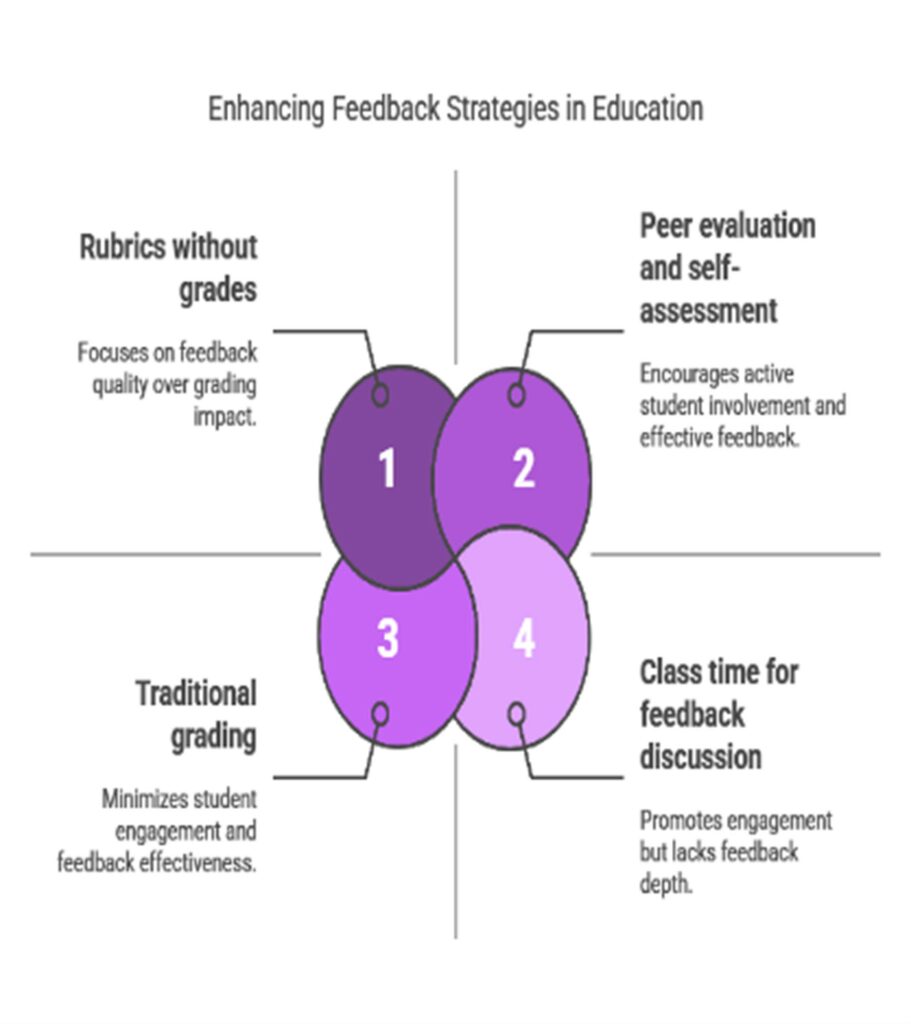
Separating grades (values, numbers, percentages, levels, letters) from feedback (verbal or written comments, directions on where to improve, outlining strengths, suggestions for next steps) is the first step in ‘ungrading’ your course.
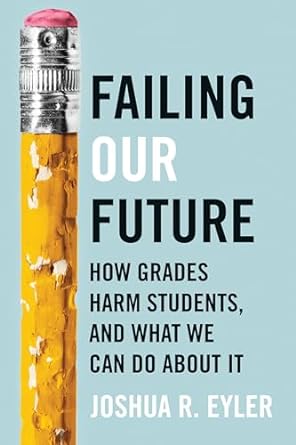
Ungrading meaning rethinking the way we are putting values on student learning and critically reflecting on what grades are doing to student learning — are they helping? are they fostering the right context and culture of growth and development?
Once you see this separation and understand how grades (putting a value on learning) doesn’t aid in the learning process, ungrading practices and pedagogies will become more clear.
Ungrading: Separating Grades from Feedback [PDF]
This handout provides ideas on how to separate grades from feedback and build more student reflection, metacognition and ongoing feedback into the student learning experience.
An Alternative Grading Glossary
The following is a curated collection of readings, blogs, books, research articles and other writings that explore what ungrading means from various viewpoints and disciplines and how it can be applied in the post-secondary classroom (and still give a letter or number for student transcripts!)
Instructors Who Support Alternative and Ungrading Approaches
Maha Bali

Maha is an Associate Professor at the Centre for Learning & Teaching at the American University in Cairo, Egypt. She is a full-time faculty developer and educator teaching digital literacies and intercultural learning.
- Bali, M. et. al. (January 5, 2021) Alternative Approaches to Grading | Video
- Bali, M. (March 23, 2019). Reflections on Ungrading for the Fourth Time | Blog post
- Bali, M. (March 20, 2018). Ungrading My Class — Reflections on a Second Iteration | Chronicle of Higher Education Article
Susan Blum

Susan is a professor of anthropology at University of Notre Dame. She’s been teaching college students for over 30 years and for much of that time she was a conventional grader. Since around 2106 she has given up grading except for handing in grades at the end of term.
- Blum. S. (December, 2020). Ed. Ungrading: Why Rating Students Undermines Learning (and What to do Instead)?| Forward by Alfie Kohn | Book from West Virginia Press
- Blum story within article by Supiano, B. ( July 19, 2019). Grades Can Hinder Learning. What Should Professors Use Instead? | Web Page
- Blum, S. (November 14, 2017). Ungrading: The significant learning benefits of getting rid of grades. Inside Higher Ed. | Web Page
- Blum, S. (December 20, 2016). Living and Learning with Risk: Against Rubrics and Grades. How “Ungrading” Allowed my Students to Try Some New Things | Blog post
Cate Denial

Cate Denial is the Bright Distinguished Professor of American History, Chair of the History department, and Director of the Bright Institute at Knox College in Galesburg, Illinois.
Laura Gibbs

Laura is an instructor at the University of Oklahoma where she joined in 1999. She’s been teaching fully online courses since 2002. She teaches general education courses in the humanities.
- Gibbs, L. (2020). Getting Rid of Grades | Book chapter in “Ungrading Why Rating Students Undermines Learning (and What to Do Instead)” | Blog Post
- Gibbs, L. (2016). (Un) Grading: It can be done in college | Guest post on Education Week Teacher | Blog Post
- Gibbs, L. (2016). Teaching: Ungrading for More Feedback. Personal Blog Post found on site Anatomy of an Online Course | Blog Post
Clarissa Sorensen-Unruh
Since 2002, Clarissa has been a full-time chemistry instructor at Central New Mexico Community College. In her classes she uses ungrading, blogs and encourages open and engaged pedagogies. The story of all of her ungrading experiences are found on her main blog website at: https://clarissasorensenunruh.com/ungrading/
- Sorensen-Unruh, C. (January 14, 2020). Ungrading: What is it and why should we use it | Blog post on ChemEd XChange
- Sorensen-Unruh, C. (January 3, 2020). Ungrading: Prototype II (General Chemistry II) | Blog Post
- Sorensen-Unruh, C. (Feburary 10, 2019). Ungrading: A Series (Part 1) | Blog Post
Jesse Stommel

Jesse Stommel has written some seminal blog posts on this topic over the past few years and has ungraded his English, digital humanities, film and communications courses for decades. He is co-founder of Digital Pedagogy Lab and Hybrid Pedagogy. Jesse has been an educator since 1999 and currently teaches at the University of Denver.
- Stommel, J. (October 26, 2017). Why I Don’t Grade | Blog Post
- Stommel, J. (2023). Ungrading for Equity | Blog Post
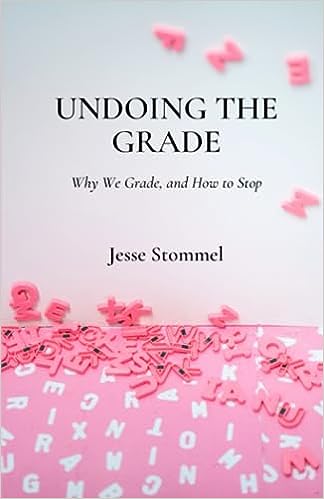
- Stommel, J. (2023). Undoing the Grade: Why We Grade, and How to Stop. Hybrid Pedagogy Inc., Denver, CO. Overview Post and Open Version
- Stommel, J. (May 9, 2022). Ungrading and Alternative Assessment | YouTube video of Presentation
- Stommel, J. (January 3, 2022). Compassionate Grading Policies | Blog Post
- Stommel, J. (June 11, 2021). Ungrading: An Introduction | Blog Post
- Stommel, J. (June 2, 2021). Grades are Dehumanizing: Ungrading is no Simple Solution | Blog Post
- Stommel, J. (March 3, 2020). What if We Didn’t Grade? A Bibliography. | Blog Post
- Stommel, J. (February 6, 2020). Ungrading: an FAQ. | Blog Post
- Stommel, J. (March 11, 2018). How to Ungrade | Blog Post
Peer Assessment
Peer assessment (sometimes referred to as review) is a process where students evaluate and provide feedback to another student.
When students actively participate in the evaluation process for their peers, they gain autonomy and choice, which evidence shows enhances engagement. Whether the evaluation is formative or summative, when implemented correctly, this process benefits both student and instructor.
For students, engaging in peer assessment encourages them to interact with assessment criteria which will benefit their own work, while suggesting alternative assessment ideas to their peers (Mulder, Baik, Naylor, & Pearce, 2014). Added to this, students learn how to provide peer feedback, an essential attribute to their life beyond the college walls. Typically, when engaged in peer evaluation, it is noted that students provide more feedback than instructors which can be invaluable for learning.
For instructors, making space by not having to grade assignments can offset time spent focused in more intentional teaching in other areas or properly guiding students through the per assessment process. Working in collaboration with students in this manner, helps an instructor to understand any misconceptions the peer assessor may have when providing feedback, and is available to steer the student to correct the misunderstanding which may have gone unaddressed otherwise.
Let’s not forget that students might not always enjoy the peer feedback process, and instructors may experience pushback. Students may find it uncomfortable to grade their peer or provide feedback on something that they are themselves unsure of. However, it is important to share the evidence behind this strategy to demonstrate the benefits for both them and their peers.
- McGill offers a great resource about how to design peer assessment complete with ideas for assignments and how to use rubrics.
- U of Alberta also has some relevant information on peer assessment.
- Cornell provides examples of how to “get started” with peer assessment.
- UBC provides examples from faculty who have integrated peer assessment as well as information on how to get started.
If this is a strategy that you wish to integrate into your course, contact CTLI for support.
Self Assessment
In post-secondary education, students are used to the age-old practice of handing in an assignment and nervously waiting till it is returned with a grade attached. Flipping this process and encouraging self-assessment encourages students to be a realistic judge of their own work and how to make room to improve. When students become more self-aware about their learning and can take steps to make change, this is motivating and helps them to develop self-directed learning qualities that will benefit them after college life is done.
Self-assessment not only increases student self-awareness but supports the student to set clear goals on how to improve and strive towards next steps in the learning process. Self-assessment can be used in both formative and summative ways using ideas from the examples below. As you read, consider how you might incorporate some of these into your course to support student self-assessment.
Strategies to Promote Self-Assessment
Wrappers
This guide from Cornell provides many examples of how self-assessment can be used using something called “wrappers” for homework or for an exam. The intent here is to have the student work through the questions before and after the assignment/exam. Having students reflect on what went well and how preparation might change based on this idea also supports metacognition.
Cornell University, Center for Teaching Innovation: Self-Assessment
Teach Anywhere also has information and examples for you to work from:
- Cognitive Wrappers – Ideas for NIC Instructors [PDF]
- Cognitive Wrappers: Using Metacognition and Reflection to Improve Learning – Jose Bowen Website
- Exam Wrappers – Carnegie Mellon University Teaching and Learning Centre Site
- Assignment Wrapper – Word – Short Version
- Assignment Wrapper – Word – Long Version
Rubrics
Rubrics can aid in the self-assessment process. This helps students identify areas for improvement and take ownership of their learning process, providing a clear framework to evaluate their own work and gain an understanding of high-quality performance.
The most common rubrics are:
- Analytic rubric: Breaks down each assessed component and provides feedback on each.
- Holistic rubric: Evaluates the entire work, looking at overall quality and performance.
- Single point rubric: Simplified version of analytic rubric, making it easier for students to interpret.
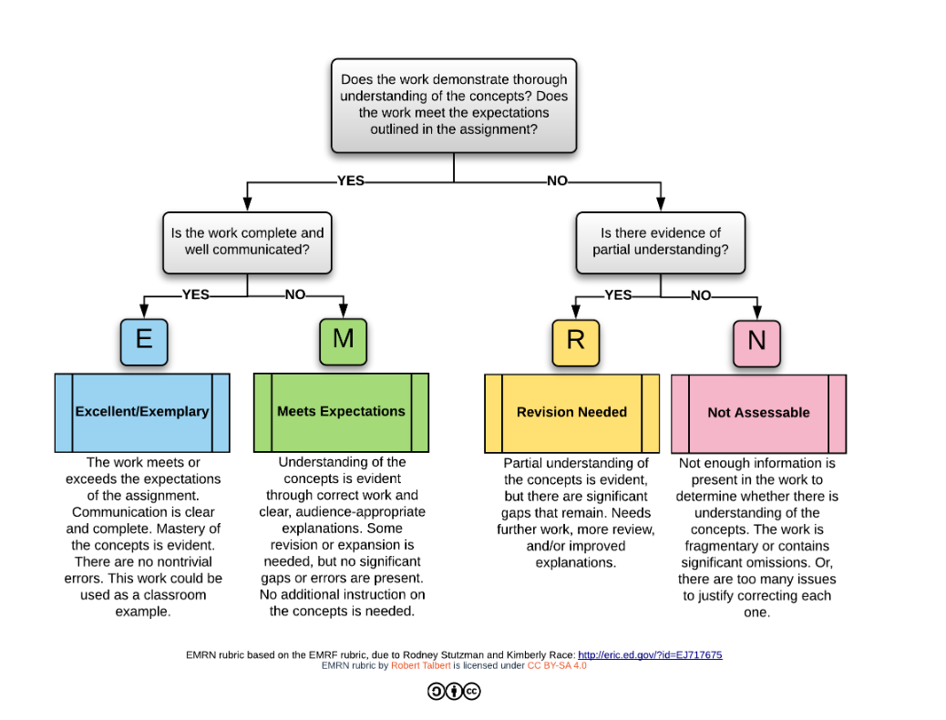
- EMRN rubric: 4 level rubric (see below)
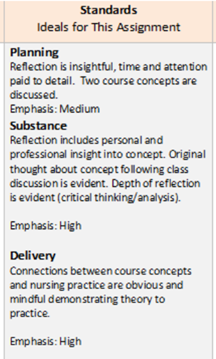
This rubric was used in Practical Nursing level 1 for a reflection assignment.
In this example, students are encouraged to add in their reflection to the left-hand column and the instructor adds their assessment to the right side. The student assigns their grade and the instructor agrees or alters with feedback for rationale in doing so.
The “emphasis” helps to guide students on where and how much effort to put into the section.
Consider making a small Kaltura video with a completed rubric example on screen to demonstrate to students how self-assessment works!
If you want to integrate self-assessment into an assignment – contact CTLI for support.
EMRN rubric: Each letter can align to points as indicated by instructor: 20. 15, 10, 5 for example.
To explore more, begin here:
- McGill University: Rubrics: The Basics
- University of Waterloo: Rubrics: Useful assessment tools
- Carlton: – Examples
- Western University: Examples and links to other sites
- Conestoga: Rubrics
ePortfolios
Curating and Sharing Reflections and Examples of Learning Throughout the educational Journey
“ePortfolios can be implemented in a variety of ways for teaching and learning, programmatic assessment, and career development. ePortfolios enable students to electronically collect their work over time, reflect upon their personal and academic growth, and then share selected items with others, including professors, advisors, and potential employers. Because collection over time is a key element of the ePortfolio process, employing ePortfolios in collaboration with other high-impact practices provides opportunities for students to make connections between various educational experiences.” — (AACU High Impact Practices)
Overview
ePortfolios in higher education are digital collections of a student’s work, skills, and learning achievements. They allow students to showcase their progress, reflect on their learning, and connect coursework to personal or professional goals. Unlike traditional assignments, ePortfolios foster deeper engagement by helping students present their best work in a meaningful way. They are also customizable, allowing students to include multimedia elements like videos, images, and hyperlinks to demonstrate their abilities.
For educators, ePortfolios offer a valuable tool for assessing students holistically. They provide evidence of a student’s development, critical thinking, and creativity across courses. Institutions can use ePortfolios to align with accreditation standards and track program outcomes. Additionally, ePortfolios serve as a professional showcase, bridging the gap between academic learning and real-world applications for students
Benefits for Student Learning
ePortfolios offer several benefits for student learning by promoting reflection, deeper engagement, and the integration of knowledge across courses and experiences. They encourage students to reflect on their learning process, helping them make connections between academic content, personal growth, and future goals. This reflective practice fosters metacognition, which improves critical thinking and problem-solving skills. ePortfolios also allow students to track their progress over time, motivating them to take ownership of their learning and develop a sense of achievement.
In addition to reflection, ePortfolios support personalized and applied learning. By incorporating multimedia elements such as videos, images, and hyperlinks, students can creatively demonstrate their knowledge and skills. ePortfolios enhance students’ ability to connect learning across disciplines and showcase their competencies to employers or graduate schools. This ability to synthesize learning improves academic outcomes and prepares students for success in a digital world.