
Assessment Strategies
Assessment Focused + Simple
20 Fair, Clear and Simple IDeas for Assessing Learning
Twenty pedagogically-sound ideas for the assessment of student learning in both online (asynchronous, synchronous and blended) and face-to-face classes with the intent to foster a more flexible, accessible, inclusive and supportive learning environment for all students. Choose one or two and learn more.

Aim for 3–5 formal assessments with no one assessment worth more than 40% (as per North Island College Policy 3–33) unless you have a program with external adjudication or regulatory requirements that indicates otherwise. In most courses, 3–5 well-designed and aligned assessments are often sufficient for students to appropriately demonstrate core learning outcomes. Include many informal assessments to help provide feedback to students and give you a broader picture of student learning. A larger number of assessments doesn’t mean you have more data to determine a grade. Too many assessments can create increased student stress/anxiety and most likely will not give students the best experiences to demonstrate their learning. Too many assessments causes more work for instructors to mark and manage.

Ensure all formal assessments are directly linked to course learning outcomes. Note: Not all learning outcomes require a formal assessment. Once you have linked the outcomes to your assessments, consider the instructional activities for your course. This is called constructive alignment of a course. Students should see a direct linkage from the learning outcome to the course activities and the formal assessments. Consider listing your learning outcomes on your assignment instructions and marking tools.

Ensure students are 100% clear on what is expected of them. If possible, provide an example or two so students know what to do. Consider making a video describing the assessment, the criteria, and the expectations. Students with all abilities will be able to download the video, stop it at any point, take notes, replay the video, and have your words to refer to when they are doing the assessment.

Consider giving students choice around the media formats for demonstrating learning (e.g., computer vs. paper, in-class exam vs. take home, presenting on video or live), choice within an assessment (e.g., 3 out of 4 essay questions, 10 out of 15 math questions) or choice between assessments (e.g., writing a paper, or doing an oral presentation, or creating a video, or building a concept map, or teaching classmates). Choice builds engagement in the learning experience. Choice is a core principle of Universal Design for Learning.

Non-disposable assignments are activities that add value to the local or global communities, professions, or disciplines. They are assignments rooted in current and relevant issues, topics, or challenges. They are assignments not likely to be tossed out after a course is complete. Students appreciate non-disposable assignments because they are more engaging and fun to do. These types of assignments are often publicly shared (e.g., a website, blog post, publication etc.) Also consider assessments that are authentic – meaning they are focused on messy, complex real-world situations.

Keep your marking tools, especially rubrics, simple and easy to use. Single point rubrics are one example of uncomplicating assessment. A single point rubric is a collection of statements about what is expected written in the middle of a 3‑column chart. A blank column to the right is for comments about work exceeding learning expectations. A blank column to the left for work not yet meeting the learning expectations. Single point rubrics focus on what is expected and give space for instructor comments and student self-reflections.

Ask students to assess themselves before handing in their assignments or after doing a test – by answering a specific set of questions about how they undertook the assignment, what went well, what they learned etc. This is called a learning wrapper and it can be used for an assignment, lesson, or exam. Give students marks for completing the learning wrapper. Learning wrappers build metacognition and self-regulated learning in students by forcing them to think about not just the outcome but the process of learning.

A professionalism (or academic behaviour) rubric outlines a collection of actions and activities of an academically honest and engaged student. It is like a checklist with descriptive phrases. Build with students. Discuss as a class. 1/3 through course have students self-reflect on the components. 2/3 through course have them self-reflect again on their first comments and provide updated thoughts. Near end of course have students review previous two reflections and assign themselves a grade or level or some final assessment about their work throughout the term in being prepared and engaged in the learning. Instructor reviews and gives a final mark or assessment.

Assessment is best when there are many opportunities for students to demonstrate their learning and receive immediate feedback. This could be a short quiz, a written paragraph, a post in a discussion forum, an outline for a project, a 2‑minute video summary – with both self-reflective feedback, along with peer or teacher feedback. These assessments do not have to be for marks or if they are for marks, they are low-stakes values (5%, 10% etc.) Consider a balance of low stakes assessments to formal assessments along with course workload – aim for a good combination for optimal student learning.

Counting the number of posts or the number of replies to a post will drive you nuts when trying to assess – and is not a true indication of learning. This is an outdated practice. How about having students self-assess their contributions and provide a summary of what they learned from an online discussion? Asking students to contribute to discussions every week is not always good learning and results in overload and stress. Try doing discussions every other week or only 4–5X throughout a course.

Think about how you manage group presentations in the online format. Students frequently rate the experience as less than ideal and live class times might be better used. Construct a worthy project for online groups and ensure presentations have a component of digital engagement or peer assessment. Maybe have students summarize their learning via a short video, share the link and submit a self-reflective summary instead of live presentations.

Most students do not like group assignments mostly because they are not with the skills and abilities to manage group work or they have had poor experiences in the past. They especially dislike group assignments in the online learning environment. They are hard to schedule and find time for all group members to work together. If you want to have a group assignment, create one that has both individual accountability pieces worth 70–80% of the mark and a small (10% or so) mark for something truly collaborative they only do as a group. Provide space and suggestions for coming together to work effectively in a digital format.

Asynchronous classes need flexibility in test and quiz scheduling. Pre-scheduled and limited-time quizzes create more stress and anxiety for students and do not align with the intent of the format. Give students a day or two or three to take the quiz so they can work around their schedules. Once they start the quiz you can constrain the time.

Cheating often happens when questions or components of an assignment are easily “Googled” or found on websites like Course Hero or Chegg. Academic surveillance software is not the solution and is harmful to students in terms of privacy, stress, anxiety, and monitoring activities. Create questions that require higher order thinking, use varied question types, have students sign an honesty contract, refrain from using publisher test banks etc.

If you teach in a cohort program, check in with other instructors of courses your students will most likely be taking. Find out their due dates and times when students might be busiest and work collaboratively to find dates that will not result in too many items due at the same time. Even if you do not teach in a cohort-based program, ask your students when other assessments are due and possibly adjust your course due dates. Students will appreciate you working collaboratively to build a balanced schedule of assessment dates.

If students are submitting assignments or taking tests in the evenings or on the weekends, Student Technical Services is not available to help – and, most likely you also are not available for help. Have assignments and tests due/be submitted during times when NIC support staff are available to help them with uploading issues, technical problems etc. Remind them of the hours and contact details for NIC’s Student Technical Services.

Exams are often given to assess memory of key concepts and components, along with student abilities to apply learning to new situations. Whether online or in person, exams also create significant stress and anxiety in students and may not produce accurate results of student learning. If you are not with articulation or regulatory body expectations, consider ditching the exam for another way of allowing students to consolidate and apply their learning.

Giving feedback that is properly received and acted upon is how students learn best. Focus your efforts on giving timely and rich feedback, but also on how students receive, interpret and act upon the feedback. Provide audio feedback, written feedback, peer feedback, expert feedback, self-reflective feedback etc. – and then follow up with their interpretation, understanding and application of that feedback.

Separating grades (values, numbers, percentages, levels, letters) from feedback (verbal or written comments, directions on where to improve, outlining strengths, suggestions for next steps) is the first step in ‘ungrading’ a course. Once students see how grades (putting a value on learning) does not aid in the learning process, ungrading practices and pedagogies will become clearer. The ungrading movement is gaining momentum in creating a more compassionate learning environment for all.

Consider asking your students to help design the formal and informal assessment components. Often called ‘co-constructing learning’ or ‘students as partners’, involve students in the design and development of a courses’ assessment (or pieces of it). Working together will build greater student engagement and their understanding of the learning process.
Non-Disposable Assignments
“If you’ve heard me speak in the last several months, you’ve probably heard me rail against “disposable assignments.” These are assignments that students complain about doing and faculty complain about grading. They’re assignments that add no value to the world – after a student spends three hours creating it, a teacher spends 30 minutes grading it, and then the student throws it away. Not only do these assignments add no value to the world, they actually suck value out of the world. Talk about an incredible waste of time and brain power (an a potentially huge source of cognitive surplus)!
What if we changed these “disposable assignments” into activities which actually added value to the world? Then students and faculty might feel different about the time and effort they invested in them. I have seen time and again that they do feel different about the efforts they make under these circumstances.”
David Wiley, Killing the Disposable Assignment
Key Readings and Examples
Here are some key readings and examples of non-disposable assignments (also called renewable assignments or sometimes called open pedagogies). Feel free to check them out.
Readings
- Paskevicius, M. & Knaack, L. (2017). The Non-Disposable Assignment: Enhancing Personalized Learning | Slideshare Deck
- Wiley, D. (2013). What is Open Pedagogy? Iterating Towards Openness | Blog Post
- DeRosa, R. (n.d.). Reduced Disposability | Website
- Ragad Anwar; Jessica Kalra; Maggie Ross; Daryl Smith; and Vicki Vogel (n.d.). Renewable Assessments Chapter in Encouraging Academic Integrity Through a Preventative Framework | Book
- Hendricks, C. (2015). Non-Disposable Assignments in Intro to Philosophy | Blog Post
- Hendricks, C. (October 29, 2015). Renewable assignemnts: Student work adding value to the world | UBC Blog Post
- Levine, A. (February 21, 2017). The Challenge of Non-Disposable Assignments | Blog Post
- eCampus Ontario (January 16, 2018). An Era of Disposable Assignments? | News Post
- Seraphin, S. B., et al. (2019). A Conceptual Framework for Non-Disposable Assigsnments: Inspiring Implementation, Innovation, and Research | Published Journal Article
- Katz, S. and Van Allen, J. (2020). Evolving Into the Open: A Framework for Collaborative Design of Renewable Assignments | Published Journal Article
Examples of Non-Disposable Assignments
- NOBA Project — 2016–17 Student Video Award Winners — Students creating resources as assignments | Website
- Jhangiani, R. and DeRosa, R. (2018). Open Pedagogy Notebook: Sharing Practices, Building Community | Assignment Examples | Website
- Open Education Group (2017–2018) Renewable Assignments | Website
- University Central Florida | Foster Meaningful Learning with Renewable Assignments | Website
- Hendricks — Open Pedagogy Examples of Class Activities | Website
- Project Management for Instructor Designers | Open Book (Pressbooks platform) by students and faculty at Brigham Young University which now includes multiple video case studies; completely rewritten examples in-text; alignment with the Project Management Professional certification exam; an expanded glossary; and downloadable HTML, PDF, ePub, MOBI, and MP3 versions of the book (among other improvements). The book is also used as the official course text at least one other university.
- Open Pedagogy Examples | Bcampus Google Doc List
- Chem Wiki which later became a LibreText is one of the largests non-disposable assignments through a collaboration of students and faculty doing a non-disposable assignment | Chemistry LibreText
- From Consumer to creator: Students as producters of content | Simon Bates’ Class Creating learning objects | Assignment Steps | Website
- Beasley-Murray, Jon. (n.d.) Wikiproject: Murder, Madness, and Mayhem. Wikipedia. Retrieved from https://en.wikipedia.org/wiki/Wikipedia:WikiProject_Murder_Madness_and_Mayhem
20 Tips for Creating Multiple-Choice Questions
This page lists the essential tips for writing effective multiple-choice questions.
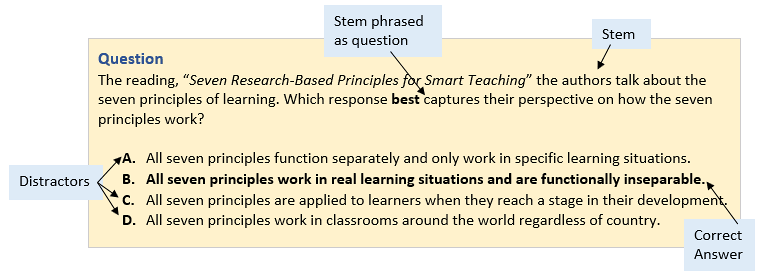
- Each question should only be designed to assess one single objective/purpose. Do not aim to assess more than one concept or content item per question.
- Each question should include one and only one correct or clearly best answer. One alternative is the correct answer.
- Put each choice on a different line with a letter choice. Don’t put all on one line.
- Place the student tasks in the item stem (stem is the question/problem). The item stem should clearly state the question to be answered e.g., select the best response, select the most accurate response, select the most appropriate answer etc. Students need to know their actions without having to read the response options.
- Put repeated terms in the item stem. (e.g., articles, words that start each answer)
- The stem may be in the form of either a question (best) or an incomplete statement (okay) – but should be worded positively if possible. For example: The capital of British Columbia is and then a listing of 4 choices…should be better words at “Which of the following cities is the capital of British Columbia?” and then the listing of choices.
- Construct four suggested solutions (alternatives). Research indicates 4 is a good number. Ensure each alternative is worded clearly and concisely. Irrelevant material should be avoided.
- Three alternatives are incorrect or inferior alternatives (distractors). The purpose of the distractors is to appear as plausible solutions for those students who have not achieved the objective being measured by the test item. Do not use absurd or unbelievable distractors because that just gives away the answer or makes it far easier to guess from fewer plausible choices. Try to make all the distractors as homogenous as possible so only the student who has fully understood the question can easily select the correct answer.
- Make sure all responses are relatively equal in length. Avoid making the correct response either the longest or the shortest in length. Often the correct responses are the longest.
- Put options in a logical order, if possible. (e.g., alphabetical, chronological so no bias and so students don’t try to guess because or the order they are listed)
- Make sure all the grammar, punctuation and spelling are correct. Use simple, precise, and unambiguous wording. Students will be more likely to select the correct answer by finding the grammatically correct option.
- Avoid grammatical clues to the answer. (e.g., an, a – which indicate a vowel/non-vowel word).Ensure items are not interdependent meaning the information in one question should not supply the answer to another or the next question.
- Do not include unneeded words. Keep simple.
- If “no” or “not” is used, bold the word. Try to avoid using negative constructions in the stem. Students may not be able to find an incorrect answer without knowing the correct answer.
- Try to avoid use of “all of the above” – use reduces effectiveness of question and test score reliability. Students merely need to recognize two correct options to get the answer correct.
- Try to avoid the use of “none of the above” as you’ll never know if students know the correct answer.
- Avoid using (a) no-exception words such as never, all, none and always (they signal an incorrect response) and (b) qualifying words such as often, seldom, sometimes (signal correct responses).
- Place the correct answer in each possible position equally often or align with an answer key.
- Use capital letters (A. B. C. D.) rather than lower case letters (e.g., “a” gets confused with “d” and “c” with “a” if the photocopying isn’t clear)
- Emphasize higher level thinking where you can by asking students to analyze, compare, contrast etc. Higher level questions do not necessarily take more time to develop. Students will appreciate questions that make them think than just simply recall on memory.
More Help? Writing Good Multiple Choice Questions by Cynthia J. Brame
Two-Stage Assessment
Promoting Collaboration and Feedback for Students

Two-stage assessments can provide students with an engaging alternative to traditional assessment. The first stage of the assessment is completed individually and in the second stage students complete the same assessment in groups of 3 or 4. This assessment method incorporates collaborative group work in a test or exam setting. During a test student motivation is high and instructors can use this high incentive to promote and enhance learning and content retention.
Implementation
Stage 1: A standard individual test written for a duration of approximately 2/3 of the total time.
Stage 2: In the second stage, students will complete the same test in small groups for the remaining 1/3 of the time. The students have already worked on each question during stage 1 so completing the same exam in stage 2 takes less time and allows the group to focus on discussions and finding a consensus for the best solutions.
Best Practices for Implementation
References
Classroom Assessment Techniques
The following are some examples of formative assessment techniques that take a short period of time to do but add a lot of value to the learning experience for students. Sometimes called CATs, these were originally created by Angelo and Cross in 1993 via their book by the same name.
Method |
Description |
How To Use |
| Ticket-Out-The-Door | During last few minutes of class, students write response to a question or two about class concepts. Hand in as exit class. | Review/read all before next class and use to clarify, correct or elaborate more for students. |
| One Minute Paper | During the last few minute of class, students write response to “Most important thing I learned today” and “What I understood the least today”. | Review/read all before next class and use to clarify, correct or elaborate more for students. |
| Muddiest Point | Similar to One-Minute Paper – but only ask students to describe what they didn’t understand during class and what they think might help them. | Same as One-Minute Paper but if many students have same problem, reteach concept another way. |
| Student-Generated Test Questions | Divide the class into groups and assign each group a topic on which they are to each write a question and answer for next test. | Use as many of the questions as possible on next test. |
| Memory Matrix | Students fill in cells of a two-dimensional diagram with instructor-provided labels such as a comparison chart outlining similarities and differences in two columns against a variety of concepts in the discipline. | Tally the number of correct and incorrect responses. Look for patterns amongst the incorrect responses. Address in class. |
| K‑W-L Chart | Label three charts K (What I KNOW Already), W (What I WANT to Know) and L (What I have LEARNED). Complete the first two before a unit/topic and the last one at end. | Discuss with students perceptions of what they thought they knew, what they have come to know etc. |
| Directed Paraphrasing | Ask students to write a layperson’s “translation” of something they have just learned (geared for a non-expert audience) to assess their ability to comprehend/transfer concepts. | Categorize student responses according to characteristics you feel are important. Address in class. |
| One Sentence Summary | Students summarize knowledge of a topic by constructing a single sentence to cover the core concept. The purpose is to require students to select only the defining features of an idea. | Evaluate the quality of each summary in brief fashion. Note if students have identified the core concepts of the class topic. Share with students. |
| Prior Knowledge Survey | Short survey you give students at beginning of course or any new unit/topic on concepts to be studied. | Review immediately and make adjustments to classes based on what class knows/doesn’t know. |
| Think-Pair-Share | Give the class a question. Allow everyone to think on own for a few minutes jotting down some thoughts. Then ask students to pair up with a peer and discuss thoughts for another few minutes. Can do groups of 4 as well. Ask to share with whole class. | Use when you want to have a better discussion by a greater number of students. By thinking alone first and with small groups of peers, shared responses should be richer and more varied. |
| Application Cards | After teaching a theory, principle or procedure, ask students to write down at least one real-world application for what they have just learned to determine if they can see the transfer of their recent learning. | Quickly read through once and categorize them according to quality. Pick out a broad range of examples to share with the class the next day. |
| Weekly Report | Written by students each week in which they address three questions: What did I learn this week? What questions remain unclear? And What questions would you ask your students if you were the instructor to find out if they understood the material? | Read at end of each week, categorize responses and share with class. Follow up on unclear questions with class or small group of students. |
| ConcepTests | Instructor presents one or more questions during class involving key concepts, along with several possible answers (multiple choice). Students indicate (by show of hands, or poll voting) which answer they think is correct. If most of the class has not identified correct answer, students are given a short time to persuade their neighbor(s) that their answer is correct. The question is asked a second time to gauge class mastery. | Often lasts a few minutes but uncovers misunderstandings, and great conversation amongst students. Share answer after second voting session to see how the class responses changed or didn’t change. |
| Instructor Meetings | Instructor meets informally with students either in class or after class to answer questions, inquire about conceptual understanding or provide feedback on student learning. | Design specific questions to help guide the meeting and address concepts and understandings you want to know more about. |
| Question-And-Answer / Class Discussion | Instructor creates a series of questions to pose to the class or smaller groups for discussion. Students may prepare through homework or in class with responses. | Provide feedback to students on how well they engaged in discussion. Ensure all students had a chance to participate and follow up next class with areas for clarification. |