
LaFever
Indigenizing Learning Outcomes
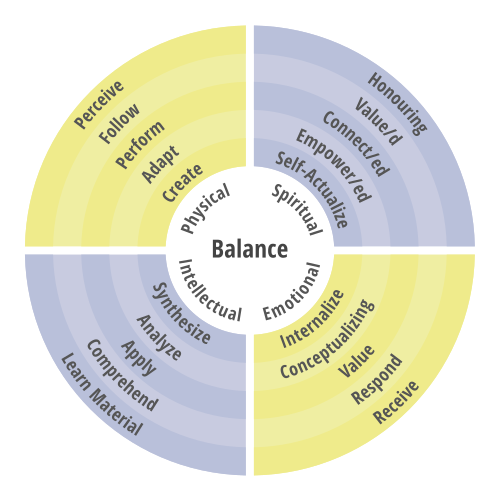
LaFever has elaborated on the categorizations developed by Bloom and Fink to include a 4‑quadrant model based on the Medicine Wheel, that includes the spiritual aspect of learning. By including the additional ‘spiritual domain,’ LaFever provides a model for indigenizing learning outcomes and course design.
The Spiritual Domain Includes:
- Honouring — refers to being conscious and aware of our own thoughts and feelings, without judging, and being open to new experiences.
- Value/d - refers to relationship building that acknowledges the importance and worth of qualities relating to spiritual well-being.
- Connect/ed - relates to developing a sense of group belonging (e.g., in the classroom, community etc.).
- Empower/d — relates to an giving and receiving support in an environment that fosters confidence and strength.
- Self actualize/d - becoming who we are meant to be.
Pros of LaFever
- Spiritual domain is added to a taxonomy with which many people are already familiar (Bloom).
- Is more inclusive for indigenous students and for diverse students in general.
- Invites us to reimagine how we teach and assess in ways that also support mental health and well-being.
Cons of LaFever
- Typical college modes of assessment do not lend themselves well to assessing the spiritual domain of learning.
- More challenging for non-indigenous instructors to apply appropriately and without inadvertently reinforcing colonial approaches.
- Eequires reinterpreting the roles of both the teacher and students (which may be easier in some areas than others).
Sample Verbs & Progression for Creating Outcome Statements
Honouring
- Consider
- Mediate on
- Be aware
- Seek
- Allow
- Listen
- Observe
Value/d
- Empathize
- Honour
- Acknowledge
- Balance
- Exemplify
Connect/ed
- Consult
- Work with
- Support
- Cooperate
- Participate
- Develop
Empower/ed
- Gain
- Speak out about
- Advocate
- Act on
- Defend
- Influence
Self-Actualize/d
- Become
- Self-define
- Sustain
- Possess
- Dream