
Pedagogies of Care & Kindness
A pedagogy of kindness is a teaching practice that intentionally cultivates respectful, compassionate, and supportive relationships—between teachers, students, and learning communities—in order to foster trust, belonging, equity, and deeper learning.

It typically involves:
- Care as a professional responsibility
Educators attend to students as whole people, acknowledging emotional, social, and cultural realities alongside academic goals. - Relational trust
Learning environments are built on mutual respect, clear expectations, and generosity of interpretation rather than suspicion or control. - Equity and inclusion
Kindness is not “being nice” or lowering standards; it actively challenges exclusion, marginalization, and deficit thinking. - High expectations with support
Students are held to meaningful academic standards while being provided with flexibility, feedback, and scaffolding to meet them. - Attentiveness and responsiveness
Teaching adapts to students’ contexts (e.g., trauma, disability, cultural norms, life circumstances) rather than assuming neutrality. - Ethical presence
Instructors model empathy, humility, patience, and accountability in how they communicate, assess, and exercise authority.
- Practice Facilitation with Presence, Empathy, and Awareness
- Presence: create a short welcome video; add weekly announcements and ‘check-ins’ in Brightspace or via email; provide audio / video feedback; offer synchronous meeting options
- Empathy: check in individually with students; offer support (and direct students to other supports) to students who are struggling; be approachable
- Awareness: survey students in first week (e.g., to find out what tech they have or what challenges they might be facing in online learning) use low-risk ice breaker activities to create community; build in regular formative feedback options to ‘check-in’ on how students are doing
- Create Choice, Challenge and Collaboration through Course Design
- Choice: provide different options for engaging in course content and for assessment
- Challenge: encourage students to try new things and to stretch themselves; show you believe in them; assess learning through content creatio
- Control: allow students to create a portion of the class content, suggest ideas for assessment, and co-create grading rubrics
- Collaboration: give students opportunities to learn from each other
- Constructing meaning: use video as a starting point for discussion; invite students to add videos, images and other content they can find to demonstrate concepts
- Consequences: have students share their work; use peer assessment
- Create Learning Activities for Diverse Learning Domains
- Affective Domain: activities that require students to receiving, responding, valuing, organizing, and internalize ideas, e.g., reflective journals, exploring opinion pieces
- Cognitive Domain: activities that require students to remember, understand, apply, analyze, evaluate, and create, e.g., case studies, research projects, presentations
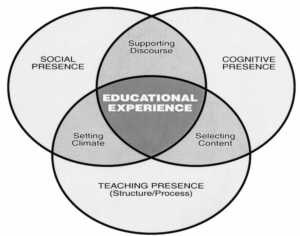
- Apply the Community of Inquiry (CoI) Framework
- Social presence: enables students to project themselves as real people, fostering open communication, trust, and collaboration
- Cognitive presence: encourages learners to construct and confirm meaning through sustained reflection and discourse, promoting deep learning and intellectual engagement
- Teaching presence: involves the design, facilitation, and direction of cognitive and social processes, ensuring a structured and supportive learning environment
By intertwining these elements, CoI creates a rich, interactive online community where learners feel connected, motivated, and engaged. This holistic approach not only enhances the learning experience but also contributes to higher satisfaction, retention, and success rates in online courses.
- Pedagogies of Care: Open Resources for Student-Centred and Adaptive Strategies in the New Higher-Ed Landscape | Website by Contributing Authors of the West Virginia University Press (2020)
- A Pedagogy of Kindness | Blog post by Cate Denial (August 2019) — this is an excellent article to start with around pedagogies of care and kindness. Cate writes about her experiences as an educator changing her practices and seeing the outcomes of such changes.
- Designing for Care: Inclusive Pedagogies for Online Learning | Presentation Text and Slideck by Jesse Stommel (June 2020)
- Pedagogies of Care | Video (3 min) by Dave Cormier, University of Windsor (May 2020)
- An Online Pedagogy of Kindness with Cate Denial | Podcast for Think UDL (Summer 2020)
- Pedagogies of Care — Universal Design for Learning | Podcast by tea for teaching — Rebecca Mushtare and John KaneState University of New York with Thomas J. Tobin (June 2020)
- Pedagogies of Care — Equity and Inclusion | Podcast by tea for teaching — Rebecca Mushtare and John Kane State University of New Yorkwith Dr. Cyndi Kernahan and Dr. Kevin Gannon (July 2020)
- The Community of Inquiry Model (CoI Framework) Dr. Serhat Kurt, November, 2024